ecommerce Integrations: ERP and WMS with Magento 2
We provide comprehensive integration services for ERP, WMS, and data buses, ensuring consistency and automation of business processes.


Our idea
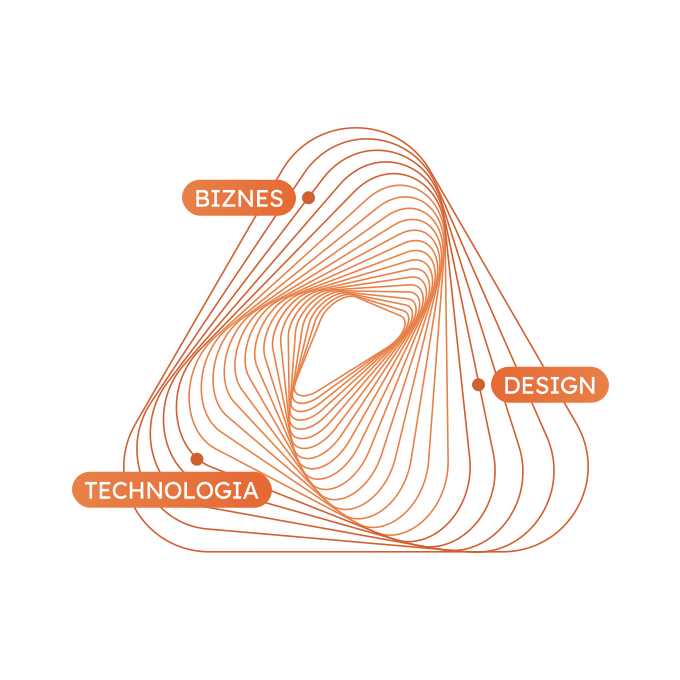
We do ecommerce. And we know-how.
We understand your company’s needs, minimize technical debt, and design scalable systems that support long-term growth. From pre-implementation analysis and design to integrations and migrations, and on to stable operations and tailored functionalities – we build ecommerce together, ready to face tomorrow’s challenges.
What can we do for you?
Experience with multiple systems
We have extensive experience working with leading ERP and WMS systems, including SAP, Comarch, IFS, Asseco, Vendo, Oracle, Microsoft Dynamics, Symfonia, Omnipack, Linker, WayToSend, Baselinker, and even smaller or custom solutions.
Reducing technical debt
Our integrations help reduce technical debt and optimize existing systems, such as organizing ERP databases, improving your ecommerce efficiency.
Business Process Model and Notation (BPMN)
Using BPMN visualizations in our integrations allows precise modeling and optimization of business processes, enhancing control and operational management.
Reliable and detailed system logs
Our solutions deliver accurate and detailed system logs, simplifying problem diagnosis, reducing repair time, and ensuring full operational transparency.
Selection of integration technologies and tools
We help choose the best integration technologies and tools for your business, ensuring optimal performance and scalability (SOAP, REST API, GraphQL, or even traditional CSV files).
Error reduction through automation
Integrating ERP and WMS significantly reduces human errors in operational processes, contributing to order accuracy and better customer service quality.
Scalability and easy maintenance
Our integrations are designed for easy maintenance and flexible growth in the rapidly changing ecommerce environment.
Real-time operations monitoring
Our solutions enable real-time monitoring of warehouse and operational processes (e.g., using Graylog), making it easier to identify bottlenecks and respond quickly to changing business needs.
Our mission / ERP / WMS

See the results
Explore selected projects and read case studies in a concise format.

JKB / FairyTrees

Bielenda / MiyaCosmetics

Bioderma / Esthederm

LaMania
References that speak for themselves
Dynamics, changing circumstances, and our approach to work - our clients will tell you themselves. See what it's like to work with us.

The e-com.house Team helped us with a comprehensive implementation of the ecommerce business model. Despite the difficult conditions related to the coronavirus pandemic, as well as the number of parties involved and the complexity of the project, within a few months we managed to add a strong online presence to our current business. E-com.house was a real support for us in the entire process and in various areas – from technology, through UX, to growth marketing.
Daniel Biegaj
Ecommerce & Marketing Director w Benefit Systems
sklep.yes2move.com
We've been working with e-com.house on all things ecommerce since may 2018. Apart from being 100 percent professional and reliable, they are also really nice people 🙂 Their expertise allows us to make decisions quicker while helping us to avoid mistakes that are easy to make when you're getting started with your own ecommerce business. e-com.house also acts as our technological partner as their team supports and adjusts our entire IT infrastructure to the demands of our quickly developing online store.
Alina Sztoch
Co-founder Kubota Store
KubotaStore.pl
What sets the e-com.house team apart from the competition is their focus on the client and their ability to see a bigger picture when analyzing client's needs. At the same time they pay great attention to detail. Thanks to their comprehensive knowledge, the team can not only help you in creating your digital strategy, but also make it easy for you to implement and execute it. They have a holistic approach to the digital brand building process - they appreciate both the importance of content and the need to monetize it. Working with them has been a great pleasure.
Hanna Rydlewska
Digital Director 'Vogue Polska'
Vogue.pl
E-com.house took over the maintenance and development of our online bookstore Literia.pl in November 2018. During that time their team has proven to be very competent in using Magento - the engine that our store has been built on. Moreover, our cooperation runs in a relaxed atmosphere – the e-com.house team members I've met are simply very nice and helpful people.
Piotr Kubiszewski
Product Owner Literia.pl, Grupa Onet-RASP
Literia.pl
We've been working with e-com.house for over 2 years. During that time we've successfully migrated 6 of our online stores from Magento 1 to Magento 2, while refreshing their UX/UI with the mobile device users in mind. This has improved the overall efficiency and security of our online stores. Merging 6 separate platforms into 1 multistore has also lowered our costs. Overall, our conversion rate has increasd by 47%!
Izabela Pańkowska
UK Market Manager
LiveOutside.co.uk
E-com.house supported us during the entire process of developing and implementing our new online store. Their continuous support, regular status updates and consultations allowed us to efficiently solve current issues and ensure that the platform is compliant with the rest of our IT ecosystem. In practice, we have become one team that works together to achieve the set goal.
Daria Leśniewska
Sales & Communications Director
RISKmadeinWarsaw.com
Having cooperated with a number of companies, we were looking for a business partner and not an inflexible contractor. E-com.house has proved to be such a partner. They helped us create an online store that meets all our requirements. Their enormous knowledge, professionalism and a very high level of culture made our cooperation a very interesting experience. The product they delivered has been equipped with many features that exceed our expectations.
Piotr Jóźwik
Kierownik działu ecommerce w PCE
PartnerElectronic.eu
Learn more
How to prepare for a new ERP system integration?
How to prepare an ecommerce store for WMS integration?
What are the key benefits of using a data bus in ecommerce?
Write and let's go