
A product configurator that calculates sleeping bag temperature: Cumulus case study
Michał Kloczkowski
Published date: 2026-11-17
Update date: 2026-11-17
Have a specific question?
Changing a single option in the sleeping bag form affects three values at once: price, weight, and comfort temperature, with the price calculated separately for each currency. Cumulus sews its sleeping bags to order and has several dozen models, so there are thousands of possible combinations. Cumulus kept track of features, prices, and coefficients in spreadsheets, and that’s how it stayed; today, they’re stored on a shared Google Drive. One thing has changed: the spreadsheet got a reader. The product configurator in the store reads it and uses it to calculate the rest: how the amount of down affects the temperature and weight, and how much the sleeping bag costs in a given market.
A product you can’t fit into a list of variants
About fifty models in sixteen families: sleeping bags, quilts, and hammock top- and underquilts. That’s how many models the product configurator currently lists in the Cumulus store, and none of these names corresponds to a set price. Sleeping bags are made to order and sewn in Poland, so the buyer starts by selecting a model and then customizes their own sleeping bag using the components of their choice to ensure it meets their requirements.
In a single model, you can adjust the length and width, the amount and quality of down, the outer and inner fabrics, the filling ratio, the zipper, the hood, and additional filling. These choices multiply, so dozens of models result in thousands of combinations, and each one needs a price. Price is the simplest variable here: every single feature has a price, listed separately in four currencies, because Cumulus sells in five markets, and for some of them, there are additional customs duties calculated per model. The parameters are more complicated. More down means a heavier sleeping bag; a different fabric also affects the weight; and as the amount of down changes, so does the comfort temperature at which the sleeping bag can be used.
The word “configurator” covers two different things, and it’s better to distinguish between them right away. One type allows you to rotate a product in 3D and see a different color or shape. The other type calculates, and that’s the one we’re talking about here. The buyer selects options, and the store provides the specifications and price of the resulting product.
No one sets up a matrix of this size in an admin panel once and for all. It’s a living entity: models are added, prices change, and new markets with their own currencies and fees emerge, so it must be kept up to date.
Matrices already existed, just not in the store
Cumulus managed prices and variants in spreadsheets, and the implementation didn’t change that. The spreadsheets are stored on a shared Google Drive, and the store reads them: everything that would otherwise be entered into a form in the admin panel is still entered into the spreadsheet.
The spreadsheet lists features and their prices, separately for each currency, and photos of the features are embedded in the cells as links from Google Drive. A feature’s price can also be negative, in which case it reduces the configuration’s price. Next to it are the default configuration for each model, tables of coefficients, and customs surcharges for markets that require them. The store reads all of this and uses it as the basis for its calculations. No one has to manually copy half the data into the admin panel while leaving the other half in the file.
Data from the spreadsheets is imported into the store via the same periodic import, along with products, inventory levels, and prices. The spreadsheet instructions describe three actions: adding a product, adding a feature image, and changing a feature’s price. That is all that is needed to maintain the configurator catalog.
Teneqa 700: change the down, the store recalculates the rest
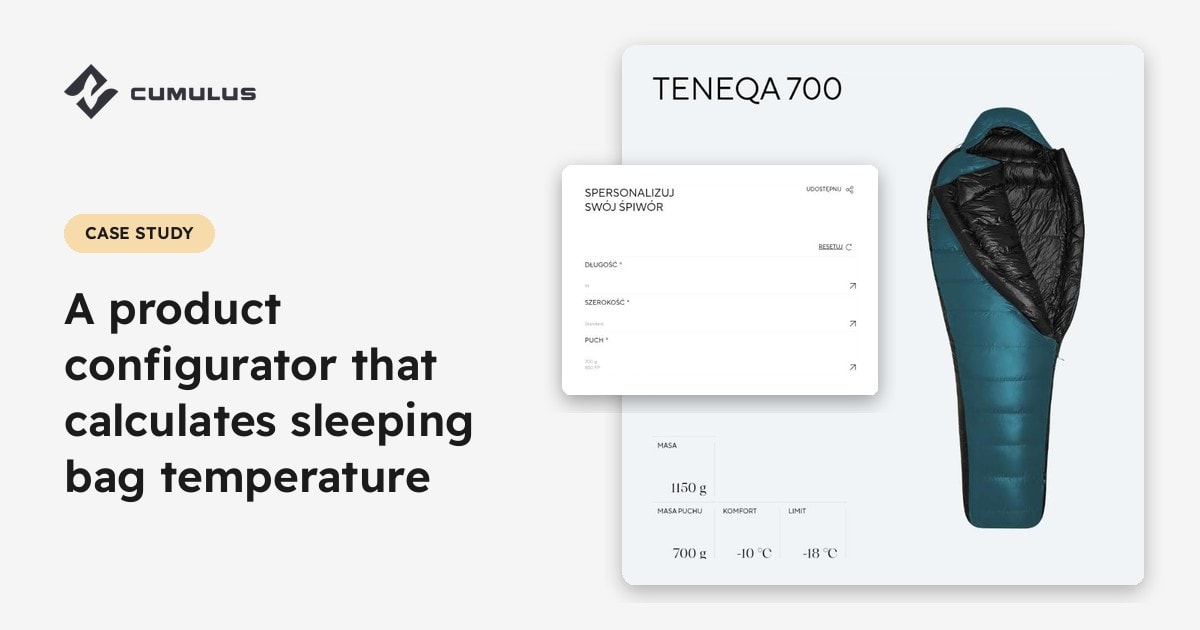
The Teneqa 700 opens to its default setting: 700 grams of down with a fill power of 850 FP, total weight 1,150 grams, comfort -10 °C, limit -18 °C, PLN 2,269. This is what the screen looked like on the day we took the screenshots, and all the figures below are from that day.
Now, one change to the form: the down quality from 850 to 900 FP. We’re not changing anything else. The amount of down drops on its own from 700 to 660 grams, the total weight of the sleeping bag falls to 1,110 grams, and comfort and limit stay where they were. The price rises to PLN 2,527.
Fill power measures the volume occupied by one ounce of down (just under 28 grams) when expanded. The higher the number, the more space the same mass fills, and it is the air trapped in the down that provides insulation. Better down lets you take out 40 grams and keep the same temperature.
The same applies in reverse. A buyer who wants a warmer sleeping bag, not a lighter one, keeps 900 FP and manually goes back to 700 grams of down: comfort drops to -11 °C, the limit to -19 °C, the weight returns to 1,150 grams, and the price rises to PLN 2,619.
Warmth depends on the quality of the down and the fill weight, so simply choosing a better material does not guarantee a warmer sleeping bag. The product configurator must combine these two factors and provide the result. Underneath lies a model that calculates the effects of a single click.
What the product configurator calculates that no person does
There isn’t a single formula behind this conversion. In an online store with a product configurator, every number displayed follows its own rule, and its parameters are listed in spreadsheets and tables next to the price list. Let’s start with the one that adjusts the amount of down when the quality changes. The conversion rests on a fill power coefficient set separately for each model and each down quality, not on a single ratio for the entire catalog. So the same switch to 900 FP takes a different number of grams out of two different models. The table of these coefficients is stored on the same drive as the rest of the data, so it’s updated in the same way as the price.
Temperature has its own conversion factor. The reference point is the model’s default configuration: the store takes the difference in grams of down relative to that configuration and converts it using the factor “how many grams of down per degree.” This coefficient varies by model, and within a model, it also varies by size and width. A longer version of the same sleeping bag reacts differently to additional down than a shorter one.
The total weight consists of several components: tape, thread, and accessories; the area of the inner fabric multiplied by its weight per unit area; and the same for the outer fabric. The number on the product card is the result of this calculation. No one ever had to enter it manually for each model, and no one has to remember to correct it later, and the buyer sees the weight of their own sleeping bag.
Prices in four currencies are entered, not converted
Where does the price of a sleeping bag come from for a buyer in Germany or the United States? The instinctive answer is: the exchange rate. A typical store maintains a single base price and converts it using the current exchange rate, often the National Bank of Poland (NBP) rate, and the rest takes care of itself.
At Cumulus, every one of these amounts is entered. The spreadsheet tracks four currencies, each in its own format: gross zloty, gross and net euros, net dollars, and net pounds, and the mapping assigns them to markets. Feature by feature, currency by currency, someone sets these values. On top of that, there are customs surcharges set for each model, again separately for each currency.
The price list isn’t all a store needs to know about a model. Alongside the prices are exclusions, that is, information about which features and values cannot be selected for this specific model, and the default values the form starts from. Without this, the configurator would suggest combinations that Cumulus does not make.
Limits and what went differently
“Comfort” and “limit” are not our terms. These are the names given to these temperatures by the EN ISO 23537-1 standard, and they are measured in a laboratory using a heated mannequin. No one will conduct such a test for every combination that can be entered into the form.
The configurator therefore does something narrower and doesn’t pretend to do more. The default configuration temperatures were provided by the manufacturer, and the store calculates the difference based on the grams of down added or removed. "Comfort -11 °C" in the last screenshot means “one degree warmer than the base version,” not “measured on a mannequin.”
The second point concerns our side: the first data model was too simple.
It did not anticipate what is now at the heart of the whole solution: that down quality has to adjust down quantity. The fill power coefficient was added later, and we scrapped our initial approach to the calculations and rewrote them from scratch. Along the way, we established the rule that additional filling does not affect the temperature, and a default configuration separate for each size. Customs surcharges were introduced when markets requiring them emerged. The rest came from real client data: missing default values, a zero temperature coefficient, and photos of features with filenames that didn’t follow the convention. Each of these situations added a validation step on the import side, because using a spreadsheet as a data source also means the store must review what came from it before calculating the price and temperature based on that data. This data model grew alongside the markets. We didn’t design it once and for all.
What this leaves in day-to-day work
The new price for a feature or the next model is entered where the price list is already maintained.
There’s one question that comes up with every change: has it gone live yet or not? The import runs periodically, and after each run, it adds the date and time of data retrieval and the completion of processing to the spreadsheet, in Warsaw time. Whoever changed the price can see in the same file whether the store has already picked it up.
Two things stayed on the buyer’s side. The configuration is embedded in the page URL, so it can be shared via a link: “Share,” “Copy Link,” and the entire set of settings is sent to whoever opens that exact sleeping bag in that configuration.
The second point is less flashy but more important. The order history shows what the buyer chose, not the model’s default variant. Without this, the configurable product ceases to be configurable after purchase: all that remains is a name, and no one will ever be able to tell how much down, and what kind, was inside.
Finally, something you can’t see in the store. The configuration logic wasn’t created just for Cumulus: it resides in the shared PIM module of the stack we’re building on, and for Cumulus, we’ve added spreadsheet import and a store view. Cumulus provides the data: features, prices in four currencies, conversion factors, and customs duties. The shared mechanism handles the calculations, while the knowledge about sleeping bags stays where it was.
Summary
Cumulus kept its price list and sleeping bag variants in spreadsheets and continues to do so there. What has changed is what happens to this data afterward: the store retrieves it, verifies it, and uses it to calculate what, given thousands of combinations, no one could calculate by hand: the amount of down at different quality levels, the comfort and limit temperatures, the weight, and the price in four currencies. This is best illustrated by the Teneqa 700: using higher-quality down reduces the fill weight by 40 grams without changing the temperature rating, while returning to 700 grams results in a one-degree increase in warmth. The data model didn’t start out in this form right away; it evolved alongside the markets. The data stays with the client, and the store calculates the implications of their choices.

Na jakie pytania znajdziesz odpowiedź w tym artykule?
What is a product configurator in an online store?
This is a tool where the buyer assembles the product themselves from available options, and the store provides the price and specifications for that exact configuration. There are two types: 3D visualization, where you rotate the product and see the appearance change, and a configurator based on options and calculations. Cumulus uses the latter: after selecting the length, fabric, and amount of down, the store calculates the weight, comfort temperature, and price in the currency of the given market.
Can a Google Sheet serve as a data source for an online store?
Yes, and that’s exactly how the configurator works in the Cumulus store. Spreadsheets on a shared Google Drive store product features, their prices in four currencies, photos of features, conversion coefficients, and customs duties, and a periodic import pulls this data into the store along with the products, inventory levels, and prices. On the store side, there’s an additional validation layer, because a manually maintained file needs to be reviewed before prices are calculated based on it.
How does an online store handle prices in multiple currencies?
There are two methods. The first is a single base price converted at the current exchange rate, for example, via integration with the National Bank of Poland (NBP). The second, used in Cumulus, is a price entered separately for each currency and separately for each configuration feature, along with customs surcharges for selected markets.
What do the comfort and limit temperatures on a sleeping bag mean?
These values are defined by the EN ISO 23537-1 standard and measured in a laboratory using a heated mannequin. No configurator runs that test for every possible combination. In the case of Cumulus, the manufacturer provides the temperatures for the default configuration, and the store displays the difference resulting from the grams of down added or removed, separately for each model, size, and width.
What determines the warmth of a down sleeping bag?
It comes down to two things: the quality of the down and its quantity. Quality is described by fill power, the volume that one ounce of down occupies when expanded, and it matters because the insulation comes from air trapped in the down. Better down provides the same warmth with less weight, so simply choosing a higher fill power does not mean a warmer sleeping bag unless you know how many grams are inside.