
Online store modernization when your store can't keep up anymore
An old store can be updated, given a new front end or rebuilt from scratch. After an audit, we recommend which path to take. We start online store modernization by checking what the store really uses and finish with a plan in stages.


Every change in an old store costs more than it should
Meanwhile, sales keep growing. You need tiered prices for B2B customers, a new market or a new currency, and you hear that it can't be done.
Behind symptoms like these there are usually years of modules and workarounds piled on top of each other. Every new vendor added something, hardly anyone removed anything. That's why we start modernization by checking how much of it actually works for sales.
Online store modernization has three paths, and the choice depends on what already works
Your store doesn't have to run on Magento. We have modernized a custom-built system, a store on PIMCore and a store on WooCommerce.
Update and cleanup
The engine stays because it serves sales well. We upgrade the version, remove dead modules and apply security patches. We work on a separate copy of the store. We update a Magento store in 1-2 months, a large one in up to 3 months.Magento 2 updates & takeoversA new front end on the current engine
The engine and integrations work, but the store is slow or looks bad on a phone. We keep the backend, and the store gets a new PWA front end that talks to it through an API.Custom PWA storefrontsA rebuild or a new platform
When patching would cost more than a new store, or the platform can't handle what you need. We migrate the data and redirect old URLs to new ones, so customers and Google land where they should.Magento 2 storesWe pick the path only after the audit
An audit of a Magento store takes 5 business days from the moment we get access to the server. We work on a copy, so your store runs as usual in the meantime.
1. Audit
We check the server, modules, integrations and what the store actually uses. We finish by going through the results with you and recommending a path.2. Analysis for a rebuild
If the answer is a rebuild or a new platform, we map out the scope, integrations and stages. Pre-implementation analysis takes 3-5 weeks.3. A plan in stages
Every module gets a decision: it stays, we replace it or we remove it. Each stage has a clear completion criterion, so you know what you get after the first one.4. Work on a copy
We update or build on a separate copy of the store. Production keeps selling as usual, while we test the purchase flow and data exchange with external systems.5. Switchover
We set the date with you. The production switchover comes with a ready procedure to roll back to the previous version if something goes wrong.6. Growth after launch
Launch is where the work on the store begins. We have worked with some of our clients for over 5 years.Sometimes repairing costs more than a new store
| Repairing the old store | New store on a ready-made base | |
|---|---|---|
| Modules to maintain | 88 | about 18 |
| Maintenance work | baseline | about 3× less |
| Risk during updates | high, someone else's undocumented code | low, our modules and 4 proven third-party ones |
| Speed | theme from 2019 | Breeze, 2-3× faster |
That's what an audit of an electronics store on Magento showed. Out of 88 modules, about 18 were needed, and bringing the old store into shape would have cost more than rebuilding it on a ready-made base. We showed both options side by side. This is a recommendation from the audit; the decision is the client's. Full story: Magento audit of an electronics store.
Modernizations we have delivered
LiveOutside: six Magento 1 stores merged into one on Magento 2
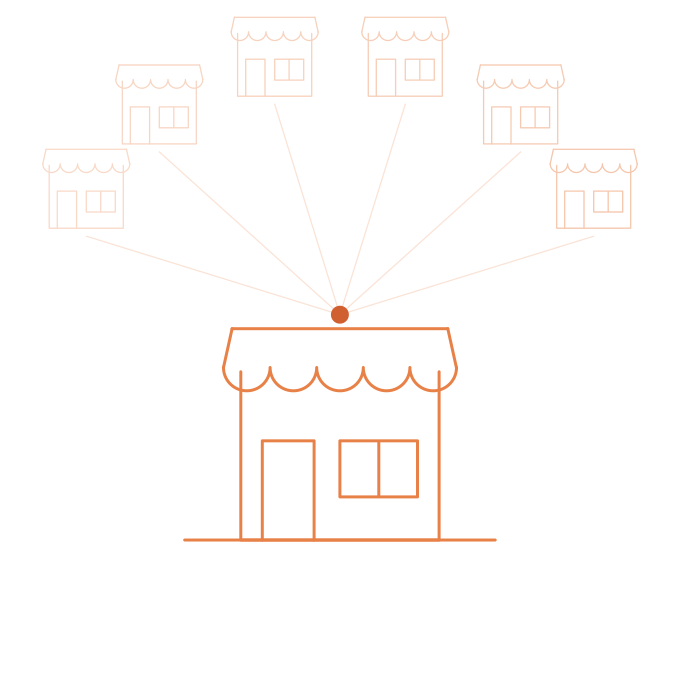
What we did: consolidated them into one Magento 2 multistore with a refreshed, mobile-friendly design.
Now: one platform instead of six, lower module costs and 47% higher conversion.
MUVE: a custom-built system moved to a new platform
What we did: a takeover and analysis, then a prototype that proved the data could be pulled out of the old system. The store moved to a new platform with a PWA front end, and a redirect map makes sure old URLs still lead to products. It took a year from analysis to launch.
Now: new countries, new modules and an AI project for product content.
One modernization without a platform change, one with a full switch
Literia.pl: takeover and move to the cloud
We took over maintenance and development of an online bookstore on Magento. We moved it to the cloud, which handles sudden traffic spikes better, and simplified ordering to a single step. The platform stayed the same.
Canpol and Lovi: from PIMCore to a shared platform
The stores of two brands, a blog and a forum ran on PIMCore with its own ecommerce. After an analysis with workshops, both B2C brands and the B2B service run on a single Magento, with PWA front ends.
First we clean up the old store, then we add AI
- Cleanup first. Fewer modules and product data in one place. Without that, an AI assistant gets the same mess your team is fighting today.
- AI as a separate module next to the platform. At MUVE, game data from several external services, including Steam, GOG and ProtonDB, is collected by a separate microservice. We wrote it with AI tools without touching the store's core.
- AI agents with human approval. At a seller of electric scooters and parts, agents prepare product descriptions, translations and graphics from PIM data, and the team reviews and approves them. The description model is self-hosted, so product data doesn't go to external services.
- devAI in store development. We write code with AI tools, and a developer reviews and approves every change.
When modernization doesn't make sense

- Patching would cost more than a new store. Then we recommend a rebuild and show both options side by side, with a comparison of maintenance work, like in the electronics store above.
- A subscription store is enough for you. You sell in one channel and have a standard cart and a few integrations. A custom store will only raise your costs, and we'll tell you that on the first call.
See the results
Explore selected projects and read case studies in a concise format.

MUVE

Canpol

Literia

Bolero
References that speak for themselves
Dynamics, changing circumstances, and our approach to work - our clients will tell you themselves. See what it's like to work with us.

We've been working with e-com.house for over 2 years. During that time we've successfully migrated 6 of our online stores from Magento 1 to Magento 2, while refreshing their UX/UI with the mobile device users in mind. This has improved the overall efficiency and security of our online stores. Merging 6 separate platforms into 1 multistore has also lowered our costs. Overall, our conversion rate has increasd by 47%!
Izabela Pańkowska
UK Market Manager
LiveOutside.co.uk
E-com.house took over the maintenance and development of our online bookstore Literia.pl in November 2018. During that time their team has proven to be very competent in using Magento - the engine that our store has been built on. Moreover, our cooperation runs in a relaxed atmosphere – the e-com.house team members I've met are simply very nice and helpful people.
Piotr Kubiszewski
Product Owner Literia.pl, Grupa Onet-RASP
Literia.pl
The e-com.house Team helped us with a comprehensive implementation of the ecommerce business model. Despite the difficult conditions related to the coronavirus pandemic, as well as the number of parties involved and the complexity of the project, within a few months we managed to add a strong online presence to our current business. E-com.house was a real support for us in the entire process and in various areas – from technology, through UX, to growth marketing.
Daniel Biegaj
Ecommerce & Marketing Director at Benefit Systems
sklep.yes2move.com
We've been working with e-com.house on all things ecommerce since may 2018. Apart from being 100 percent professional and reliable, they are also really nice people 🙂 Their expertise allows us to make decisions quicker while helping us to avoid mistakes that are easy to make when you're getting started with your own ecommerce business. e-com.house also acts as our technological partner as their team supports and adjusts our entire IT infrastructure to the demands of our quickly developing online store.
Alina Sztoch
Co-founder Kubota Store
KubotaStore.pl
What sets the e-com.house team apart from the competition is their focus on the client and their ability to see a bigger picture when analyzing client's needs. At the same time they pay great attention to detail. Thanks to their comprehensive knowledge, the team can not only help you in creating your digital strategy, but also make it easy for you to implement and execute it. They have a holistic approach to the digital brand building process - they appreciate both the importance of content and the need to monetize it. Working with them has been a great pleasure.
Hanna Rydlewska
Digital Director 'Vogue Polska'
Vogue.pl
E-com.house supported us during the entire process of developing and implementing our new online store. Their continuous support, regular status updates and consultations allowed us to efficiently solve current issues and ensure that the platform is compliant with the rest of our IT ecosystem. In practice, we have become one team that works together to achieve the set goal.
Daria Leśniewska
Sales & Communications Director
RISKmadeinWarsaw.com
Having cooperated with a number of companies, we were looking for a business partner and not an inflexible contractor. E-com.house has proved to be such a partner. They helped us create an online store that meets all our requirements. Their enormous knowledge, professionalism and a very high level of culture made our cooperation a very interesting experience. The product they delivered has been equipped with many features that exceed our expectations.
Piotr Jóźwik
Head of Ecommerce at PCE
PartnerElectronic.eu